

At NMAI, we support cross-border M&A between Japanese and Indonesian companies. This time, we would like to introduce the M&A we assisted with in 2023 as a case study.
Interview Date: March 29, 2024
Indonesia Company Information
- Company Name: PT. Claro Kreasi Abadi (Indonesia)
- Business Description: Maintenance (cleaning) services for buildings, commercial facilities, private companies, and government agencies
- Number of Employees: 923 (as of December 2022)
Investor Company Information
- Company Name: HACK JAPAN Holdings Co., Ltd. (Yamanashi Prefecture)
- Business Description: Open innovation, HRD, environmental engineering, AI solutions, material solutions, media solutions
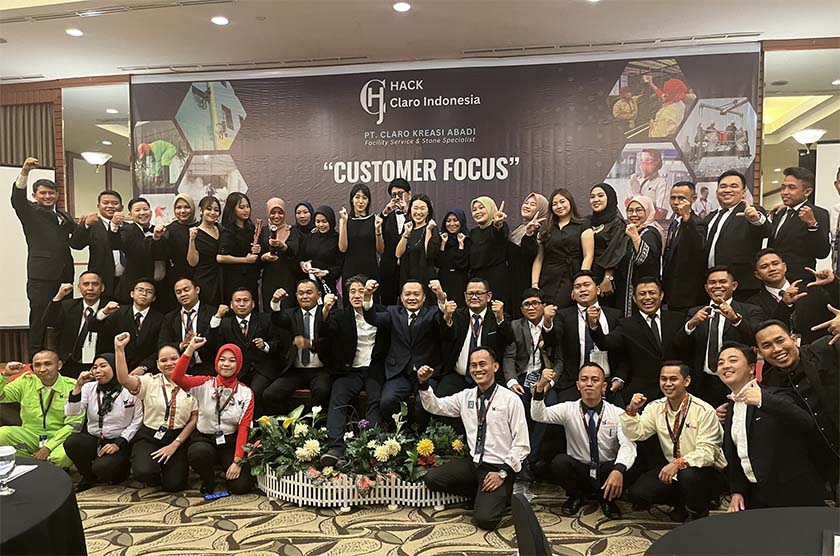
HACK JAPAN Holdings (Yamanashi Prefecture) is committed to proposing new value by combining Japan’s buried technologies and human resources, expanding diverse businesses beyond the framework of a holding company. The company actively pursues overseas expansion and acquired the Indonesian facility service company, PT. Claro Kreasi Abadi (hereafter referred to as PT. Claro) in December 2023.
We spoke with President Togo Hosaka of the acquiring company about the key points in doing business with overseas companies. (Interview date: February 1, 2024)
The Key to Success in Overseas Business is Whether a Trustworthy Management System Can Be Established Locally
—First, please introduce your business.
Hosaka: To explain our business, I will start with the name HACK JAPAN. I have always found “challenge” to be my purpose in life, so I wanted to include that word in our company name. However, “challenge” or “try” lacks appeal. While searching for a good word, I read an interview with Mark Zuckerberg of Facebook, where I learned that the word “HACK” is used within Facebook to mean challenging limits. That’s why I chose “HACK.”
I wanted to challenge the world from Japan and aimed to become a representative company of Japan, so I added “JAPAN,” resulting in HACK JAPAN.
Therefore, one of the characteristics of our business is that we skillfully combine Japan’s buried technologies and human resources to propose new value. Our business is about finding seeds of business and nurturing them.
—What kind of businesses are you currently developing?
Hosaka: As a holding company, we mainly engage in real estate leasing, hotel management, and the operation of Japanese sweets brand “Wanonka.”
Originally, our company began when my grandfather established the first security company in Yamanashi Prefecture, called Japan United Security, in 1969. Since my grandfather’s time, we have developed various businesses, including used car sales, restaurants, and weddings, but I have always believed that diversified businesses should be separate organizations. Therefore, in 2013, I established the holding company and changed to a structure with group companies under it.
However, as I mentioned earlier, HACK JAPAN Holdings does not merely manage group companies; it develops various businesses, which is different from typical holding companies.
—You have acquired the Indonesian company PT. Claro. What was your aim in pursuing this M&A?
Hosaka: Within our group, we have a management organization that accepts and manages technical interns from Indonesia. The interns come to Japan to acquire high-level skills for three to five years, but often find it difficult to find jobs when they return home. I thought that was a great waste. Therefore, I considered creating a company in Indonesia that could serve as a receiving organization for these interns.
However, starting a company from scratch locally carries significant risks. In that case, acquiring an existing local company is less risky.
We have conducted various businesses overseas and learned that success in overseas ventures depends on whether we can secure trustworthy personnel and place them locally. In Indonesia, Yamazaki, one of our female executives, has very good connections. We were confident that we could gather trustworthy personnel in Indonesia, which gave us the confidence to proceed.
—What attractions do you see in Indonesia as a country?
Hosaka: I was attracted to the country’s future potential. The economic growth rate is over 2% annually, and it is clear that the market will continue to grow. Additionally, the population is about 280 million now and is expected to increase by 50 to 60 million in the next 30 years. In contrast, Japan is predicted to have a population of less than 100 million in 30 years. Indonesia will become a country with more than three times the population of Japan.
—What about the attractiveness of PT. Claro as a company?
Hosaka: PT. Claro is a facility service company. We also want to expand a security business in Indonesia, and since facility services are an adjacent industry, we expect synergies. I discussed such post-M&A visions from the initial meetings with the top management, and during the first board meeting after the M&A, we talked about wanting to develop in the promising security and parking sectors. We aim to leverage synergies and target an IPO in Indonesia by 2025.
—It’s been about a month since the M&A. How are you progressing with PMI (Post-Merger Integration)?
Hosaka: Our job is to secure funding to grow PT. Claro. The growth engine of the company is money; it is like blood for a human. Our job is to inject this funding. As a foreign entity, we have various ways to raise funds, but they can only raise funds in Indonesian Rupiah due to their scheme.
This means that the funding interest rate is extremely high. Currently, the funding interest rates in Japan are very low. Because we are a foreign entity, we can be of help in this regard. Additionally, establishing a governance structure is a fundamental aspect of our management.
On the other hand, personnel management, education, and evaluation should be handled by local staff. We have clearly divided roles from the beginning. Of course, we provide advice, but it is important not to interfere with areas that should not be touched, as the saying goes, “When in Rome, do as the Romans do.”
—This is an important point.
Hosaka: It is very important. We cannot do everything in a Japanese way. Especially considering religious factors. In Indonesia, there are many Muslims, and it is natural to allow time for prayers during work.
We must remember that we are working within the common sense of local companies. It is better to assume that Japanese common sense does not apply. Fortunately, the local people have welcomed us warmly, and all the former management team members continue to work with us. There have been zero resignations after the M&A.
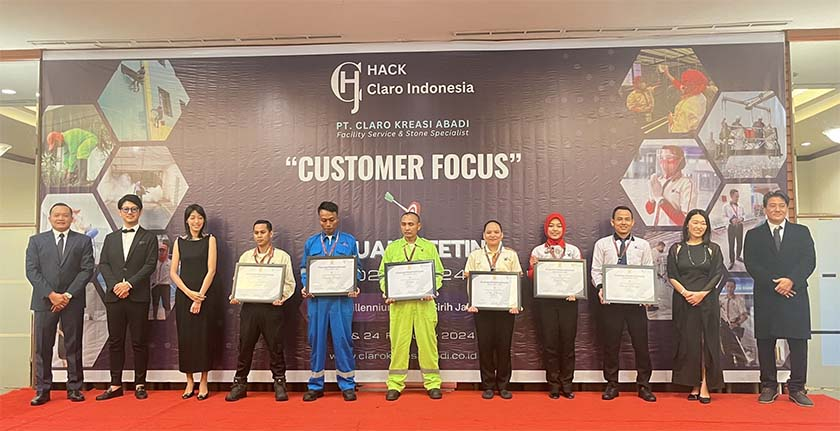
At PT. Claro, we hold an annual training session for executives once a year. During the evening social gathering, outstanding employees are awarded MVPs and other awards, with President Hosaka and Director Yamazaki serving as presenters.
—Are there any initiatives underway for building the organization?
Hosaka: We have been discussing and preparing for changes in personnel, such as who to appoint as directors and changes in financial institutions, since the deal was progressing.
I and Yamazaki from Japan are on the board, along with two trustworthy locals: Mega, who handles finance, and Endy, who handles human resources. Additionally, Joko, who is a former executive from the old management, is an extremely capable individual. Since this M&A was conducted with a solid lineup, it is progressing smoothly. I am honestly surprised at how well the organization is structured, even beyond my expectations.
Initially, Yamazaki was supposed to be stationed locally, but I told him it wasn’t necessary. The company can be managed on a business trip basis. Joko is very capable, and I think he is truly impressive. They may be more organized than Japanese companies.
I believe there is a communication gap. However, if we can share a future vision, I don’t think it will lead to significant discrepancies. The fact that the local leader is someone like Joko is significant. We started the first meeting by discussing future strategies. It is important to work with someone who can share a vision for the future.
—In what specific ways do you feel they are more organized than Japanese companies?
Hosaka: Since they are a company with only human capital, employee education is very thorough. Joko constantly thinks about how to develop human resources and maintain their quality. I spoke with a teacher who trains at the training center, and they are genuinely thorough.
In Indonesia, competitive bidding is common every year, but Joko said the way to prevent it is to “gain the trust of customers.” If they receive such education, customers will be convinced and trust them.
If a cleaner greets you or not makes a huge difference in impression, doesn’t it? I realized that the job of facility services is to enhance the value added in unseen areas.
—Finally, please share a message for business owners considering M&A with overseas companies.
Hosaka: When managing local overseas companies, it is crucial to have personnel in-house who can realize the future vision together. Without such personnel, I think it would be difficult to succeed. It is about having people who can grow together.
One-sided management and imposition will not move people. People do not move unless their hearts are moved. This is true worldwide. Everyone wants to do work that excites them and allows them to see the future. Therefore, in the end, it comes down to people. It is essential to work together with trustworthy local individuals.
Comment from NMAI
President Hosaka, who has consistently created opportunities for challenge, is considering new business developments in Indonesia, a country with significant growth potential. Through numerous communications, I believe a matching synergy with existing businesses has been achieved. His strength in confidently articulating “why we are doing this” and “what we aim to achieve,” while mobilizing those around him at key moments, left a strong impression on me.